
Dashcam Privacy in the UK: GDPR, Data Requests and Fleet Obligations
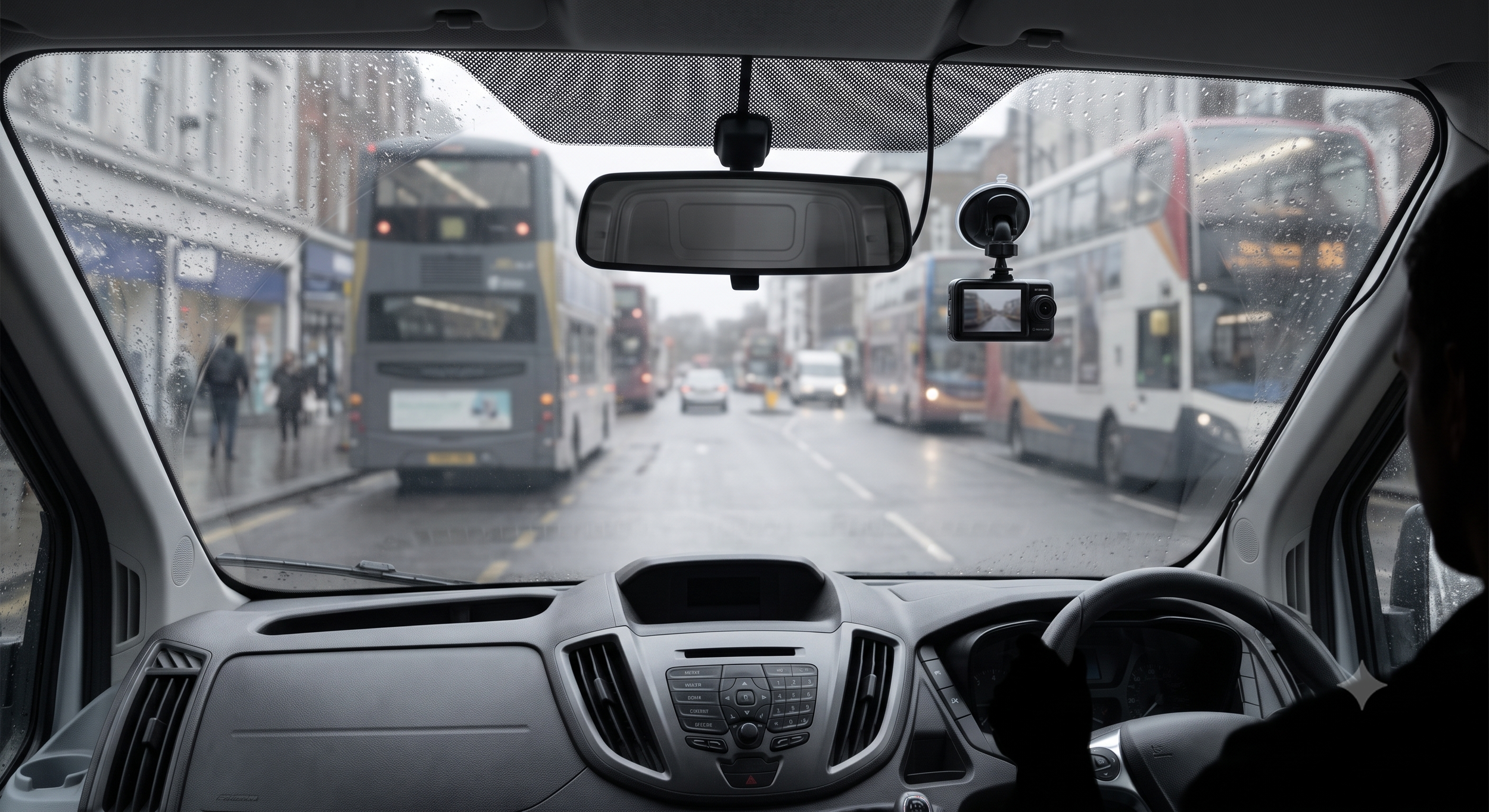
Dashcams Record More Than Your Journey
Dashcam privacy in the UK sits in a unique legal position: while the devices are completely lawful and widely encouraged by insurers, almost every mile driven records the faces, vehicle registration plates, and movements of members of the public who never consented to being filmed.
This tension is not a reason to abandon dashcams; they provide indispensable, objective evidence during road traffic accidents and insurance disputes. However, the footage captured carries heavy legal weight under UK data protection law, and the individuals captured on screen possess robust privacy rights.
Private Drivers: Benefit from a distinct, narrow "domestic purposes" exemption, though this legal safe harbor completely dissolves if footage is shared publicly online.
Commercial Fleet Operators: Face the full force of the UK data protection framework from the exact microsecond a camera system is installed across their vehicles.
This guide outlines the compliance mandates governing commercial dashcam deployment, retention boundaries, public disclosure requests, and the mechanical steps required before video files leave your network.
Does UK GDPR Apply to Dashcam Footage?
The short answer is yes, in the vast majority of contexts.
The UK General Data Protection Regulation (UK GDPR) applies whenever a video recording contains images of identifiable individuals. A clearly visible face or a readable license plate constitutes personal data. Collecting, storing, or viewing that video stream means your business is actively processing personal data, triggering immediate statutory obligations.
The Household Exemption vs. Commercial Reality
Article 2(2)(c) of the UK GDPR establishes the "domestic purposes" exemption. This completely removes the requirement for a private individual to comply with data protection rules if the recording is executed strictly for personal, family, or household activity—such as a driver recording their daily commute for personal insurance safety.
However, this exemption is fragile. If a private driver uploads an unedited dashcam clip to social media, sends it to a viral video site, or distributes it to a public forum beyond what a standard police report or insurance claim mandates, the domestic exemption falls away. The individual instantly assumes the legal liabilities of a Data Controller.
For businesses, fleet operators, and logistics firms, the domestic exemption never applies. Fleet dashcam footage is categorized strictly as commercial data processing. Your organization must operate with complete regulatory transparency from the day the cameras are deployed.
What the Information Commission Mandates
The Information Commission (the restructured, board-governed regulatory body that succeeded the old single-commissioner ICO model) heavily scrutinizes corporate mobile surveillance.
To operate legally under the latest framework updated by the Data (Use and Access) Act, fleet operators must establish an explicit lawful basis under Article 6 of the UK GDPR. While most operators rely on Legitimate Interests (Article 6(1)(f)) - citing driver safety, asset protection, and insurance defense—the business must document this via a formal Legitimate Interests Assessment (LIA).
Regulatory enforcement frameworks show that organizations routinely face severe liabilities for two systemic failures: inadequate automated deletion schedules and a failure to transparently inform data subjects that they are being recorded. Major enforcement actions against systemic surveillance providers emphasize that policies existing purely on paper, without automated enforcement, will fail an inspection.
How Long Can Dashcam Footage Be Kept?
Data protection laws do not prescribe a rigid, one-size-fits-all expiration date for vehicle footage. Instead, companies must strictly comply with the Storage Limitation principle under Article 5(1)(e) of the UK GDPR, which demands that personal data be retained no longer than is strictly necessary for the purpose it was collected.
1. Routine Footage
A dashcam clip recorded on a standard, uneventful shift serves no ongoing security purpose once the vehicle returns safely to the depot. Most enterprise fleet systems run on a cyclical loop, automatically overwriting video data every 7 to 28 days. This tight erasure window aligns perfectly with storage limitation expectations.
2. Triggered / Incident Footage
If a camera detects a telemetry anomaly (such as harsh braking, G-force impacts, or a manual driver alert), that specific video segment must be isolated. Retaining an incident clip until an insurance claim, personal injury suit, or police investigation is completely finalized is legally proportionate. Whatever timelines your business selects must be explicitly codified within a written data retention policy.
When the Police or Third Parties Demand Footage
Police Requests
Law enforcement agencies frequently request dashcam footage voluntarily to support criminal investigations. Sharing video data in this scenario is lawful under UK GDPR provisions covering Public Task or Legal Obligation, provided the requesting officer supplies written verification of the active investigation. If police compel disclosure via a formal court production order under the Police and Criminal Evidence Act 1984 (PACE), compliance shifts from voluntary to legally mandatory.
Insurance and Civil Claims
When managing a road traffic accident, transferring unedited footage to your own insurance provider is a standard contractual operation. However, requests from a third-party driver’s legal counsel require extreme caution. The video file will invariably capture third-party license plates and pedestrian faces completely unrelated to the collision impact. You are legally required to audit the clip and share only the narrow window of footage relevant to the specific incident.
Data Subject Access Requests (DSARs)
Any individual or cyclist captured by your fleet’s cameras has a legal right to submit a Subject Access Request (SAR) to review the footage. Under updated statutory rules, the processing of these requests features two major mechanisms:
The "Stop the Clock" Provision: Fleet managers have one calendar month to fulfill a SAR. However, if a request is overly vague (e.g., "send all footage of my car last month"), the law now allows you to officially pause the countdown while you demand clarification on the exact date, time, and street location of the event.
Reasonable and Proportionate Searches: The law explicitly codifies that fleets do not have to search infinite hours of raw loop archives; you are only required to execute a reasonable and proportionate search to extract the relevant file.
If a request is deemed fundamentally malicious or designed to disrupt your business, the statutory refusal threshold allows you to deny the request or charge an administrative fee if it meets the modernized standard of being vexatious or excessive.
The Redaction Mandate: What Fleets Must Do Before Disclosure
If your business distributes a video clip to an external third party or a SAR applicant, you must completely redact (blur) the faces and registration plates of all uninvolved individuals.
Distributing raw, unedited road video that exposes innocent motorists or pedestrians constitutes a severe, self-reportable data breach.
Executing frame-by-frame visual blurring manually across hours of wide-angle road video is an operational bottleneck that drains administrative resources. To safely scale this process, fleet compliance teams leverage automated computer vision.
Pimloc’s Secure Redact platform utilizes advanced machine learning to instantly detect, track, and obscure faces and vehicle registration plates across high-volume fleet video feeds. While the AI executes the bulk processing at scale, internal teams maintain a final human sign-off step to verify tracking accuracy on low-resolution, night-vision, or rain-streaked captures.
Once approved, the system burns the redaction permanently into the video's underlying data layer, ensuring the obscured pixels can never be recovered, while automatically generating the verified compliance logs required for your legal audits.
The In-Cab Audio Trap
Many commercial dashcams feature internal cabin microphones. Recording employee conversations continuously raises severe privacy concerns under workplace surveillance guidelines.
Continuous, unmitigated in-cab audio recording is highly disproportionate unless your business can demonstrate an extreme, verified security risk. If your fleet cameras possess active microphones, this processing must be explicitly disclosed within your driver privacy notices, and any internal cabin audio must be audited and muted prior to any public or judicial disclosure.
Developing an Airtight Fleet Framework
Compliance requires proactive system architecture. Before your drivers start their next shift, ensure your operations team enforces three core protocols: a formalized data retention policy that loops out routine files automatically, an accessible internal data-complaint intake route (required under modern rules before a data subject can escalate a dispute to the Information Commission), and a secure, data-destructive video redaction pipeline.
To learn how automated AI masking can secure your vehicle data pipelines and expedite public record turnarounds, visit the Secure Redact website to schedule an enterprise demonstration.
Enterprise video redaction for fleet operators.
Try Secure Redact for free.
Frequently Asked Questions
-
Yes. Any commercial dashcam footage that captures readable license plates or identifiable human faces constitutes the processing of personal data. While private commuters benefit from a strict "household exemption" for purely personal use, commercial fleet operators, transport companies, and logistics firms possess no such exemption and must comply with all statutory data rules.
-
Under the UK GDPR's storage limitation principle, video data cannot be archived indefinitely without a clear business purpose. For standard shifts where no safety trigger or collision occurs, routine footage should be overwritten on an automated loop, typically between 7 and 28 days. Only footage flagged for active insurance claims, police investigations, or formal internal complaints should be isolated and moved into long-term legal holds.
-
Yes. While a fleet operator can choose to share footage voluntarily to support an active investigation under Public Task frameworks, the police can legally compel immediate disclosure by serving a formal court production order under the Police and Criminal Evidence Act 1984 (PACE). Once a judicial order is served, compliance is mandatory.
-
Introduced under updated UK privacy legislation, the "stop the clock" provision allows fleet managers to temporarily pause the statutory one-calendar-month deadline for a Subject Access Request if the application is too broad to fulfill. The response timeline stops the moment you formally request the applicant to specify the exact date, time, and route location of the vehicle interaction, and it resumes only once they supply those details.
-
Distributing video files that expose the faces, movements, or registration numbers of uninvolved third parties constitutes a data breach under the UK GDPR. The affected individuals can launch a direct complaint against your organization, and the Information Commission possesses the statutory authority to issue formal public reprimands, audit mandates, and significant financial penalties for systemic failure to protect public privacy.