
How real-time privacy filters work in surveillance systems

Surveillance technology has evolved dramatically over the past decade.
Modern camera networks can identify vehicles, track movement patterns, detect suspicious activity, monitor occupancy levels, and provide real-time operational intelligence across cities, transportation networks, campuses, retail environments, and critical infrastructure. Advances in artificial intelligence have made surveillance systems more powerful than ever before.
At the same time, privacy concerns have grown just as quickly.
Many organizations now face a difficult challenge: how can they benefit from video analytics without exposing personally identifiable information (PII)?
This is where real-time privacy filters are changing the conversation.
Rather than collecting footage first and redacting it later, privacy filters anonymize sensitive information as video is being viewed, analyzed, or streamed. The result is a surveillance system that can generate valuable insights while significantly reducing privacy risks.
But how do these systems actually work?
What are real-time privacy filters?
A real-time privacy filter is a technology layer that automatically identifies and obscures sensitive information within a live video stream.
Unlike traditional video redaction, which is typically applied after footage has been recorded, privacy filtering happens instantaneously.
As video is captured, the system analyzes each frame and applies privacy protections before viewers see the footage or before analytics tools process it.
Depending on the use case, filters may obscure:
Faces
Licence plates
Vehicle identifiers
Identification badges
Computer screens
Documents
Mobile devices
Other sensitive visual elements
This approach allows organizations to maintain surveillance capabilities while reducing unnecessary exposure to personal information.
Why traditional surveillance creates privacy challenges
Historically, surveillance systems were designed primarily for security and evidence collection.
Privacy considerations often came later.
As a result, many camera networks capture large amounts of information about:
Employees
Visitors
Customers
Passengers
Students
Patients
Members of the public
Even when organizations have no intention of identifying individuals, the data may still exist within the footage.
This creates several concerns:
Regulatory compliance risks
Unauthorized access
Insider misuse
Data breaches
Public trust issues
Long-term storage liabilities
Real-time privacy filtering addresses these risks by limiting the exposure of sensitive information from the beginning.
The role of computer vision
At the heart of every real-time privacy filter is computer vision.
Computer vision enables machines to interpret and understand visual information from video streams.
When a camera captures footage, AI models analyze incoming frames and identify objects of interest.
For privacy applications, these objects typically include:
Human faces
Vehicles
Licence plates
Documents
Screens
Text elements
The system determines what should be protected and where it appears within each frame.
This entire process occurs within fractions of a second.
Object detection: Finding sensitive information
The first step in privacy filtering is object detection.
Detection models are trained using massive datasets containing examples of the information they need to recognize.
For example, a face detection model learns to identify:
Facial structures
Eyes
Noses
Mouths
Facial contours
Similarly, licence plate detection models learn to identify vehicle registration areas across different environments and lighting conditions.
When a live video stream arrives, the AI identifies these objects and creates bounding regions around them.
These regions become the targets for privacy protection.
Object tracking keeps filters consistent
Detection alone is not enough.
People move.
Vehicles change direction.
Objects enter and leave the camera's field of view.
To maintain effective privacy protection, surveillance systems use object tracking.
Tracking algorithms follow identified subjects across multiple frames.
This ensures privacy filters remain attached to the correct individual or vehicle even when:
Movement is rapid
Lighting changes
Objects become partially obscured
Multiple subjects appear simultaneously
Without tracking, privacy filters would flicker, disappear, or lose accuracy during motion.
Reliable tracking creates smooth, consistent anonymization.
Applying the privacy filter
Once sensitive information has been identified and tracked, the system applies a chosen anonymization method.
Common approaches include:
Blur effects
One of the most widely used techniques.
The protected area remains visible but loses identifiable detail.
Pixelation
Sensitive regions are transformed into large visible pixels that obscure identifying characteristics.
Solid masks
The information is completely covered using opaque overlays.
Synthetic replacement
Some advanced systems replace identifying information with artificial alternatives rather than simply obscuring it.
The method selected often depends on organizational policies, compliance requirements, and operational objectives.
Edge processing versus cloud processing
Real-time privacy filtering can be deployed in different ways.
Edge-based processing
Analysis occurs directly on:
Cameras
Local devices
On-site hardware
Benefits include:
Lower latency
Reduced bandwidth requirements
Greater local control
Cloud-based processing
Video streams are processed in centralized cloud infrastructure.
Benefits include:
Easier scalability
Centralized management
Continuous AI model updates
Simplified deployment
Many modern surveillance environments use a hybrid approach that combines both models.
Pimloc's Secure Redact supports flexible deployment options, allowing organizations to implement privacy workflows that align with their operational, security, and compliance requirements while maintaining high-volume processing capabilities.
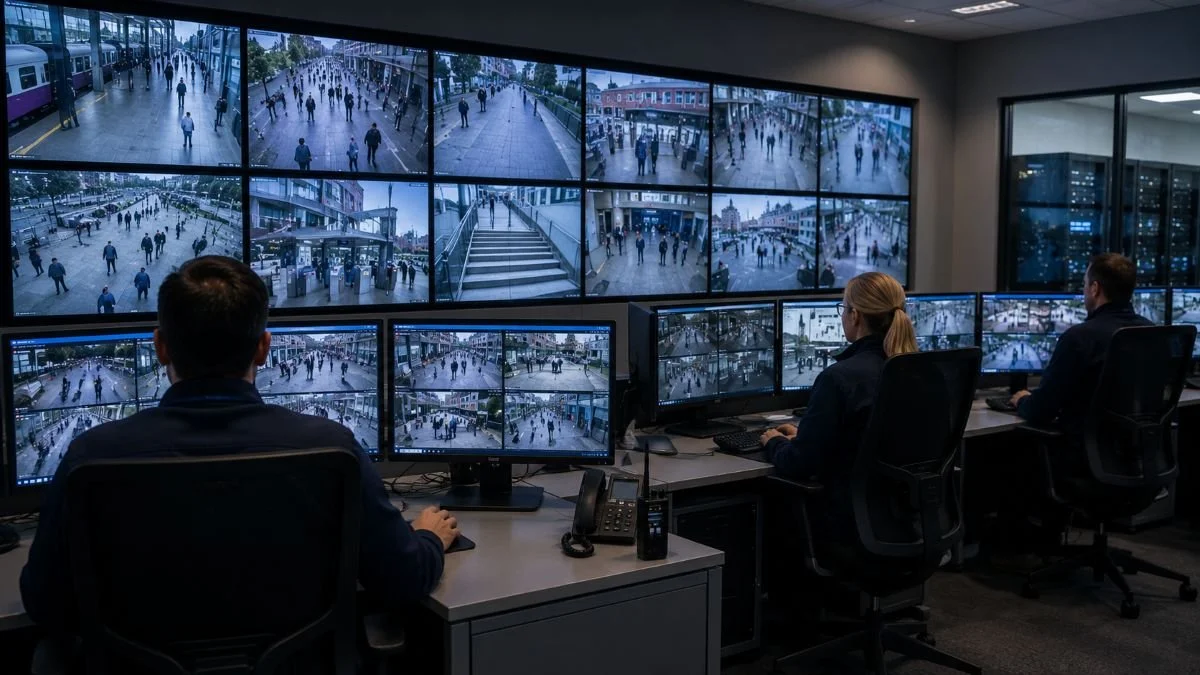
Privacy filters and video analytics can work together
One common misconception is that privacy protection reduces the usefulness of video analytics.
In reality, many analytics functions do not require personal identification.
Organizations often need to understand:
Crowd density
Traffic flow
Queue lengths
Occupancy rates
Vehicle counts
Movement patterns
Behavioral trends
These insights can be generated without exposing individual identities.
Privacy filters make it possible to separate operational intelligence from personal identification, allowing organizations to benefit from analytics while minimizing privacy risks.
Dynamic privacy zones
Some surveillance systems use dynamic privacy zones.
Instead of applying the same filter everywhere, the system adjusts protection levels based on context.
Examples include:
Public sidewalks
Building entrances
Reception areas
Hospital corridors
School campuses
Privacy rules can change according to:
Camera location
Time of day
User permissions
Operational requirements
This creates more flexible privacy management without compromising security objectives.
Role-based viewing permissions
Not every user needs access to the same level of information.
Many advanced surveillance environments combine privacy filters with access controls.
For example:
Operators may see anonymized footage.
Investigators may access approved evidence.
Administrators may control permissions.
External viewers may receive fully redacted streams.
This layered approach reduces unnecessary exposure while maintaining operational functionality.
Real-time filtering becomes one component of a broader privacy governance framework.
Challenges facing real-time privacy filtering
While the technology has improved substantially, several challenges remain.
Processing speed
Live video requires immediate analysis and response.
Even small delays can impact user experience.
Environmental conditions
Poor lighting, weather, shadows, and crowded scenes can affect detection accuracy.
Large camera networks
Organizations may need to process hundreds or thousands of streams simultaneously.
Accuracy requirements
Missed detections can create privacy risks, while excessive filtering may reduce video usefulness.
Balancing these factors requires sophisticated AI models and scalable infrastructure.
Where real-time privacy filters are being used
Adoption is expanding rapidly across multiple sectors.
Smart cities
Municipalities use privacy filters to support public safety while protecting residents.
Transportation
Transit operators analyze passenger flows without exposing identities.
Education
Schools can monitor facilities while reducing student privacy concerns.
Healthcare
Hospitals use surveillance systems while protecting patient information.
Enterprise security
Businesses balance workplace security with employee privacy expectations.
Law enforcement
Agencies can review footage while controlling access to sensitive information.
These use cases demonstrate how privacy filtering supports both operational effectiveness and responsible data handling.
Why AI is making privacy-by-design more practical
Historically, privacy protections were often applied after footage had already been collected and viewed.
This created significant compliance and governance challenges.
Advances in artificial intelligence have enabled a different model.
Today, organizations can build privacy protections directly into surveillance workflows from the moment video is captured.
Pimloc's Secure Redact exemplifies this shift by combining AI-powered detection, automated redaction, and scalable video processing capabilities that help organizations operationalize privacy-by-design principles across large surveillance environments. Rather than treating privacy as an afterthought, organizations can incorporate protection mechanisms directly into everyday operations.
Building surveillance systems that respect privacy
The future of surveillance is not simply about collecting more video. It is about managing video responsibly.
Real-time privacy filters allow organizations to maintain visibility into environments, events, and operations without unnecessarily exposing personal information. By combining computer vision, object detection, tracking, and automated anonymization, these systems create a balance between security and privacy that was difficult to achieve with traditional surveillance architectures.
As regulations evolve and public expectations continue to rise, privacy-aware surveillance will become increasingly important. Organizations that adopt real-time privacy technologies today will be better positioned to unlock the value of video analytics while protecting the individuals appearing within their footage.
From surveillance to privacy-conscious intelligence
The most effective surveillance systems of the future will not force organizations to choose between operational awareness and privacy protection.
Instead, they will deliver both.
Real-time privacy filters represent an important step toward that future, enabling organizations to extract insights, improve security, and support decision-making while reducing unnecessary exposure to personal information. With AI continuing to advance, privacy-preserving surveillance is rapidly becoming the new standard rather than the exception.