
World Cup Surveillance, FOIA, and Mass Data Collection: What Agencies Must Know
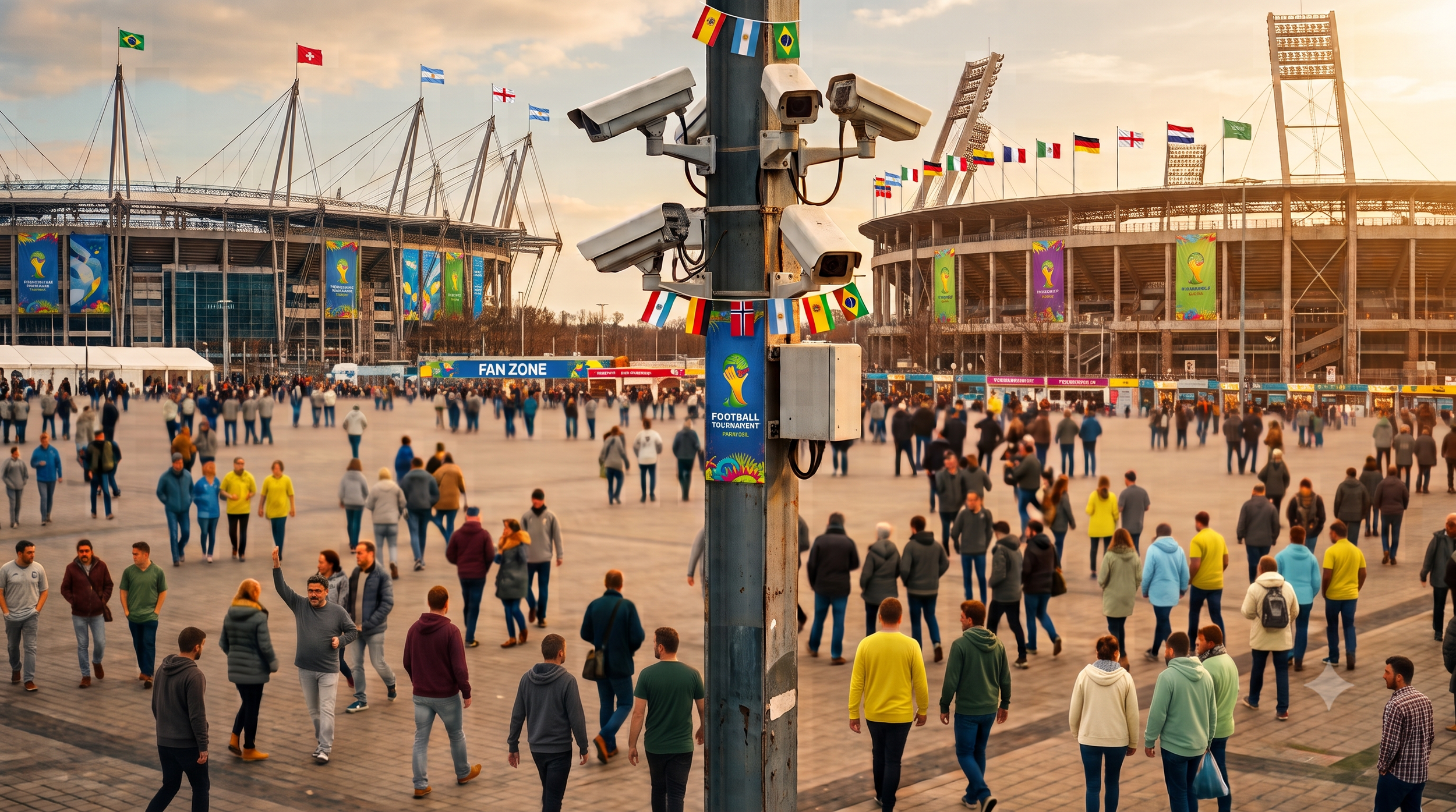
The 2026 FIFA World Cup has produced the largest, most technologically complex security and surveillance operation ever executed for a sporting event in the United States. Across 11 American host cities, a massive footprint of local, state, and federal agencies have deployed AI-driven camera grids, automated biometric check-ins, counter-drone interception platforms, and unified command centers to monitor 104 matches over a dense 39-day schedule.
Crucially, because federal agencies are deeply embedded in these command structures, any data or video footage captured by federal sensors is subject to the Freedom of Information Act (FOIA). Public agencies that have failed to establish an automated pipeline to handle this impending deluge of public records requests face severe operational backlogs and legal exposure.
The 2026 World Cup Surveillance Architecture
While local security footprints vary across host cities, several advanced surveillance technologies are operating at an unprecedented scale nationwide:
AI Analytics and CCTV Infrastructure: Municipalities aggressively expanded their physical camera grids ahead of the tournament launch. In Seattle, stadium-district CCTV networks and Automatic License Plate Readers (ALPRs) feed live video directly into automated Real-Time Crime Centers. Vancouver executed a massive central integration platform to link up to 1,000 regional municipal cameras, a blueprint mirrored across major US metros.
Biometric Facial Recognition: Stadium environments - including Gillette Stadium in Boston, Hard Rock Stadium in Miami, and Mercedes-Benz Stadium in Atlanta - have rolled out opt-in facial recognition systems at turnstiles and concession points, allowing registered fans to utilize their biometric profile as a digital ticket and payment method.
Autonomous Robot Patrols: Four-legged Boston Dynamics "Spot" robot dogs are actively patrolling perimeter lines at the International Broadcast Center in Dallas and the New York/New Jersey Stadium. While Boston Dynamics confirms these devices carry no internal facial recognition software, they act as mobile, autonomous sensor arrays feeding live video back to unified command centers.
Airspace Counter-Drone Systems: Backed by heavy federal prioritization, agencies are deploying sophisticated radio frequency and kinetic counter-drone systems to secure stadium airspaces. The FAA enforces strict temporary flight restrictions, establishing a 3-nautical-mile "No Drone Zone" around match venues, monitored dynamically by dedicated FBI aerospace teams.
Predictive Digital Twins: Enterprise contractors have constructed real-time, software-driven "digital twins" of World Cup venues, aggregating data streams from physical cameras, thermal sensors, and access turnstiles into a unified operational picture that far exceeds traditional event security capabilities.
To bankroll this massive infrastructure, the federal government authorized over $1.1 billion in targeted FEMA security grants, including the $625 million FIFA World Cup Grant Program and a $500 million Counter-UAS tracking initiative. Public safety leadership has openly described the multi-agency operation as the logistical equivalent of running 78 Super Bowls simultaneously for a month.
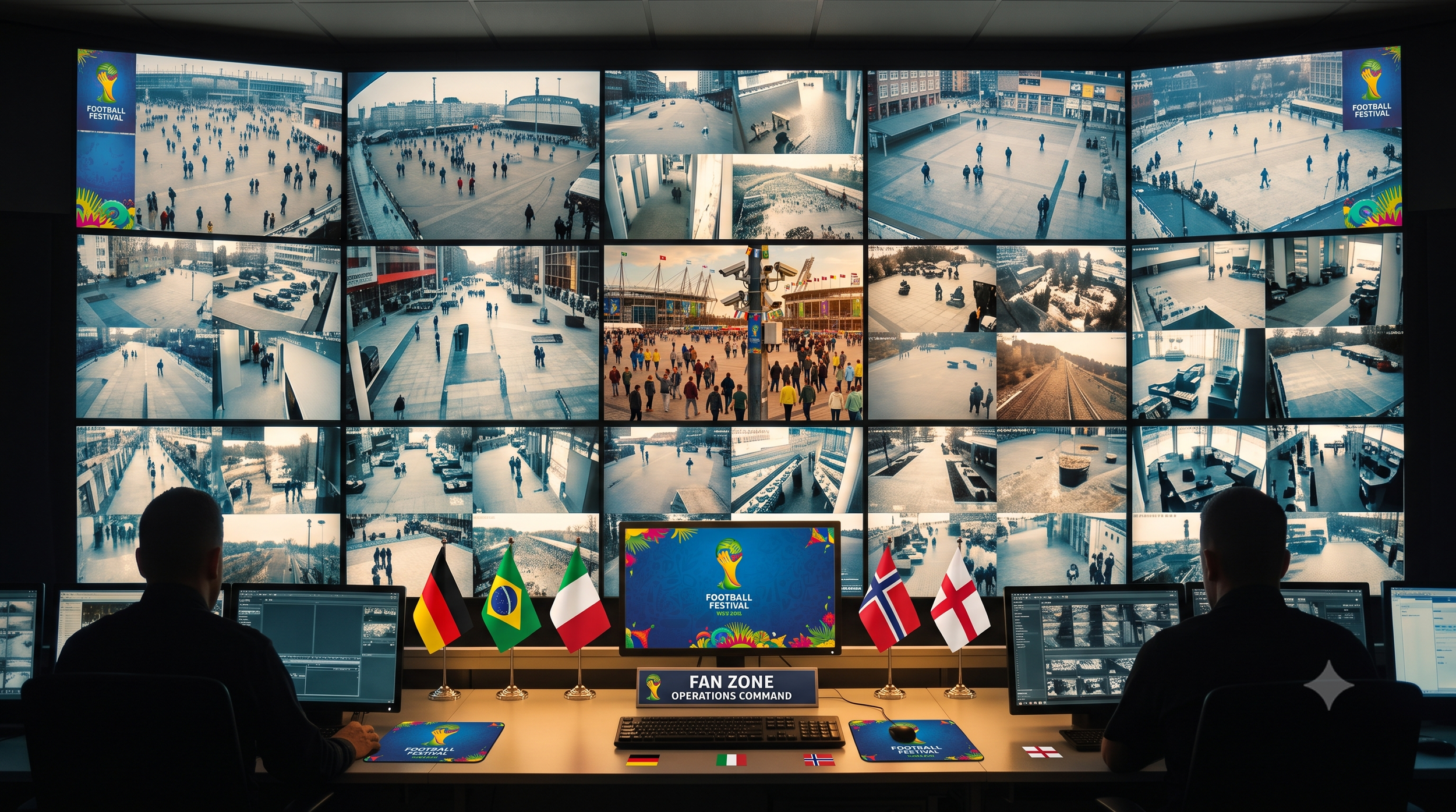
Who is Captured in the Footage?
The staggering volume of video data captured throughout June and July 2026 does not belong to a uniform demographic.
Millions of international fans traveling to the United States are being captured on advanced biometric and algorithmic tracking grids with zero meaningful notice, operated by foreign federal agencies under legal frameworks that differ drastically from their home countries.
Concurrently, domestic citizens face widespread tracking outside the stadium gates. While facial recognition entry lanes are framed as voluntary convenience features, the broader, AI-enhanced municipal camera networks monitoring transit hubs and fan zones feature no opt-out mechanisms.
Civil liberties organizations, including the ACLU, have raised urgent warnings regarding how this massive data harvest could be repurposed for long-term domestic surveillance. Civil rights groups have already documented instances of Immigration and Customs Enforcement (ICE) deploying Mobile Fortify - a contactless biometric mobile application developed by NEC Corporation - to run real-time field scans of individuals against massive federal databases.
With the State Department already mandating public social media disclosures for visa applicants, the question of whether this short-term World Cup infrastructure will be permanently absorbed into broader federal enforcement pipelines is a subject of intense public debate.
Does World Cup Surveillance Video Trigger FOIA Obligations?
Yes. The federal Freedom of Information Act grants any individual - regardless of whether they are a US citizen or a foreign national - an absolute right to request public records maintained by federal agencies. Requesters are not required to provide a justification for their inquiry. Consequently, any video clip or sensor dataset captured by a federal agency (or local task force operating under explicit federal control) during the World Cup is subject to FOIA disclosure.
This exposure presents three distinct compliance hurdles:
1. The Volume Bottleneck
A single, broad media request for BWC or CCTV footage covering a high-security stadium perimeter on a match day translates to hundreds of hours of multi-angle raw video. Agencies are legally bound to deliver initial determinations within 20 business days. Attempting to process this data stream manually will immediately collapse a records unit.
2. The Privacy Redaction Mandate
Disclosing raw surveillance footage without masking identities triggers immediate data protection violations. Under FOIA Exemption 6 (personnel and medical files) and Exemption 7(C) (law enforcement records), agencies are legally obligated to redact information that would cause an unwarranted invasion of personal privacy.
The Foreseeable Harm Standard
Per 5 U.S.C. § 552(a)(8)(A), an agency cannot legally obscure a video file simply because it fits an exemption category. Records clerks must explicitly demonstrate that releasing an unblurred face or license plate would cause a distinct, foreseeable harm to that specific bystander's personal privacy or safety.
Because the principle of segregability mandates that non-exempt video must be separated and released, agencies must systematically blur the faces and license plates of innocent fans, vendors, and bystanders while disclosing the underlying footage.
3. The International Litigant Variable
Because FOIA rights extend to international visitors, foreign nationals who suspect their biometric data was swept into federal command centers possess the full legal standing to launch records requests. This exposes agencies to complex data retention challenges, international data transfer compliance, and scrutiny over how the Privacy Act applies to non-US persons.
What Happens to the Infrastructure Post-Tournament?
History demonstrates that the multi-million dollar camera networks, automated license plate readers, and predictive digital twin software deployed for mega-sporting events do not disappear when the final whistle blows. Major international athletic tournaments traditionally function as real-world incubation testing grounds for defense contractors; once public funding establishes the hardware, it is almost universally absorbed into permanent municipal surveillance infrastructure.
What data remains permanently archived, which specific agencies retain ownership of the master files, and the ongoing legal basis for cloud-hosting these massive data pools remain critical, unanswered transparency gaps.
Strategy for Public Sector Compliance Teams
Managing World Cup surveillance data responsibly requires public safety and records teams to enact a proactive protocol:
Enforce Strict Retention Destruction: Footage collected strictly for routine, non-incident event monitoring must be bound to an automated, documented deletion cycle to prevent the accumulation of unmanageable data liability.
Deploy AI Redaction Workflows: Manually editing faces out of hundreds of hours of dense stadium crowd footage frame-by-frame is a mathematical impossibility. Agencies must leverage secure, scalable machine learning platforms to automate identity masking.
Publish Proactive Disclosures: Under federal mandates, agencies should proactively publish statistical data regarding what surveillance platforms were utilized and how the data is being managed, heavily reducing the volume of duplicative public records requests.
Even if a redacted version has been shared externally, organizations often need to retain the original recording for evidentiary purposes.
Secure Redact delivers the enterprise-grade, batch-processing video automation required to clear massive multimedia public records backlogs. By instantly isolating, tracking, and blurring civilian faces and license plates across high-volume camera feeds, the platform generates the immutable, verifiable audit trails necessary to defend your agency’s redaction choices if a disclosure is ever challenged in a federal court lawsuit.
To evaluate how automated AI redaction can protect your records unit from an operational crisis, connect with the Pimloc team to launch a secure public sector trial.
Clear FOIA video backlogs. Try Secure Redact free
Try Secure Redact for free.
Frequently Asked Questions
-
Yes. The statutory right to file a federal FOIA request applies universally to "any person," completely regardless of their citizenship or nationality. International fans who attended matches in the US have full legal standing to request copies of surveillance logs or video feeds where they believe their data was processed, without needing to state a reason for the request.
-
Agencies must redact all Personally Identifiable Information (PII) that could expose innocent individuals to an unwarranted invasion of privacy under Exemptions 6 and 7(C). This requires the systematic blurring of civilian faces, bystander movements, and vehicle license plates. Under the federal Foreseeable Harm Standard, the agency must maintain an internal log proving that releasing unblurred files would result in direct privacy injuries to those bystanders.
-
No. Exemption 7 applies strictly to records compiled for explicit law enforcement purposes. If a video asset was captured as part of a generalized, ambient public safety or crowd-monitoring operation rather than a targeted criminal investigation, a blanket Exemption 7 denial will not survive a court challenge. The principle of segregability requires the agency to redact personal privacy elements and disclose the remaining video.n text goes here
-
A Vaughn Index—a comprehensive, itemized log linking every individual video blur to a specific statutory exemption sub-section—is only required if a public records dispute escalates into formal federal court litigation. An agency is not required to deliver a Vaughn Index to a requester during the standard administrative processing phase of a routine FOIA request.
-
Automated AI redaction is the only operationally viable strategy to keep pace with large-scale event disclosures. Utilizing software that automatically identifies, tracks, and masks faces and license plates cuts per-request processing backlogs by up to 80%, allowing records clerks to maintain strict statutory turnaround deadlines while preserving the integrity of individual privacy.