
How Technology Is Changing Law Enforcement: Body Cameras, Digital Evidence, and AI

This article covers the main law enforcement technologies in use today—body-worn cameras, digital evidence management, facial recognition, and AI tools (including automated redaction)—with a focus on the practical operational and legal challenges facing US agencies.
The Law Enforcement Tech Gap: Capture vs. Management
Law enforcement technology has advanced much faster on the recording side than on the management side. American police departments now generate more video footage per shift than most major television studios produce in a month. A single mid-sized agency running 200 body-worn cameras (BWCs) can easily collect upward of 10,000 hours of footage every week.
While this footage provides invaluable evidence, it also captures the faces, voices, and deeply personal moments of bystanders, victims, and individuals who were never charged with a crime and never consented to being recorded. The hardware to capture data has outpaced the administrative infrastructure required to manage it, and that operational bottleneck is where modern agencies face severe legal exposure.
Body-worn cameras: What does the data show?
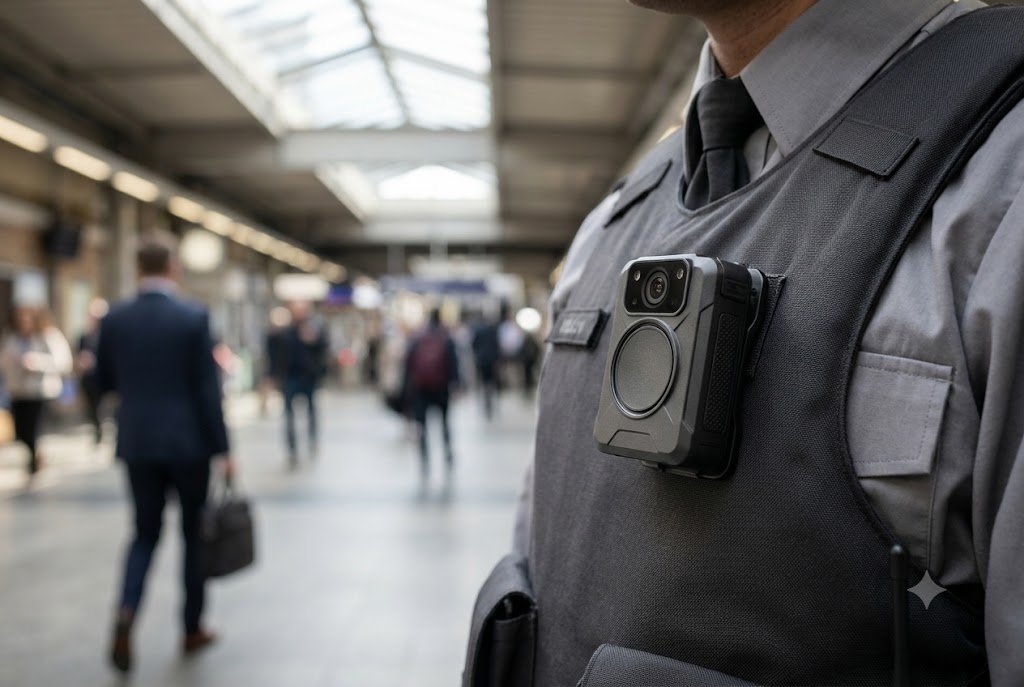
Body-worn cameras are now standard issue for the vast majority of medium and large US police departments. Early large-scale adopters demonstrated clear statistical benefits: the Las Vegas Metropolitan Police Department recorded a 27% reduction in use-of-force complaints in its first year of deployment, while the Oakland Police Department reported a 25% drop in complaints against officers post-rollout.
However, the reality on the ground is complex. Camera activation rates vary significantly depending on department culture and policy. A comprehensive study by the Police Executive Research Forum (PERF) revealed that many agencies suffer from fragmented policies regarding exactly when officers must activate recording and how metadata is categorized upon upload. Without strict, automated activation rules, the true evidentiary and community value of the hardware plummets.
Digital evidence and the chain of custody
Chain of custody refers to the chronological, immutable paper trail documenting who accessed a piece of evidence, when it occurred, what modifications were made, and whether the original remains perfectly intact. If this chain is compromised, digital evidence can be ruled entirely inadmissible in court, regardless of what the footage actually shows.
Every piece of digital evidence—whether a BWC clip, a commercial CCTV export, or a cruiser dashcam recording—requires an airtight chain of custody. In practice, many smaller agencies still handle digital media via insecure protocols: saving files to shared local drives, utilizing external video editing software outside secure loops, or sharing clips via unsecured email chains.
When defense attorneys challenge video integrity, the legal threat is rarely whether the camera was rolling; it is whether the agency can verify that the file has not been altered or improperly accessed since the moment of recording. This vulnerability is driving modern departments toward enterprise digital evidence management systems (DEMS) that automatically generate cryptographic, tamper-proof access logs.
Facial Recognition: Power, Proportionality, and Shifting Laws
Facial recognition remains one of the most powerful—and legally volatile—tools in the law enforcement arsenal. While a wave of major US cities (including San Francisco and Boston) passed sweeping municipal bans on police use of biometric surveillance between 2019 and 2021, the pendulum has noticeably swung back. Driven by public pressure surrounding retail theft and violent crime, several high-profile cities have rolled back or amended those bans, allowing police to deploy the software under strict supervisory guardrails.
The technical constraints of the software require careful policy management. Testing by the National Institute of Standards and Technology (NIST) confirmed that certain demographic matching algorithms exhibit false-positive rates up to 100 times higher for Black and Asian faces relative to Caucasian faces in "one-to-many" search pools.
Because of this inherent margin of error, federal agencies like the FBI maintain strict internal protocols dictating that facial recognition matches can only be used as investigative leads, never as standalone probable cause for an arrest warrant.
Administrators must also recognize where state-level biometric boundaries lie. While statutes like Illinois’s Biometric Information Privacy Act (BIPA) impose severe statutory fines for unauthorized biometric tracking, BIPA explicitly exempts state and local government agencies—including police departments. Instead, law enforcement exposure stems from local ordinances, departmental policy violations, and civil rights lawsuits when a flawed algorithmic match results in a wrongful arrest.
How AI is Optimizing the Evidence Workflow
To combat the thousands of hours of backlog, agencies are increasingly deploying artificial intelligence directly into their evidence management pipelines.
Automated redaction
Before an agency can release video footage to the public under a public records request or hand it over to a defense team during discovery, they are legally obligated to obscure the faces of innocent bystanders, juveniles, undercover officers, and highly private identifiers like license plates or home interiors.
Manually blurring a single hour of complex, multi-person footage frame-by-frame can consume up to five hours of a trained analyst's time.
Automated redaction platforms, such as Secure Redact, utilize advanced computer vision to automatically detect, track, and blur faces and license plates across hours of video simultaneously. On standard 1080p body-cam footage with stable lighting, AI detection rates are incredibly high. However, on low-resolution feeds (below 720p), night-vision captures, or extreme wide angles, accuracy rates naturally dip. For this reason, federal best practices dictate that an automated tool must always include a final human sign-off step before public release.
Transcription and audio processing
AI-driven speech-to-text models can instantly convert raw body-cam audio into searchable transcriptions. This allows internal affairs investigators, supervisors, and prosecutors to instantly pinpoint specific verbal exchanges across hundreds of hours of recorded shifts without needing to watch the video feeds linearly.
Public Records Requests and the Redaction Bottleneck
Public records requests for law enforcement footage have surged dramatically over the past several years, creating a massive administrative crisis. Each request requires an agency to carefully review the video, execute legally mandated redactions, and produce a clean copy within strict statutory timelines.
In California, general public records determinations default to a 10-day window, but Assembly Bill 748 (AB 748) carves out specific rules for police footage. AB 748 mandates that video and audio recording of "critical incidents"—such as officer-involved shootings or use-of-force events causing great bodily injury—must be released to the public within 45 days, unless disclosure would severely jeopardize an active investigation.
New York’s Freedom of Information Law (FOIL) imposes similarly aggressive turnaround obligations. Failing to meet these statutory deadlines leaves cities highly vulnerable to transparency lawsuits, civil rights litigation, and public backlash.
Agencies that transition from manual editing workflows to automated, batch-redaction pipelines report a drop in per-request processing times of up to 80% for straightforward dashcam or fixed CCTV requests. Removing the manual frame-by-frame editing burden is the only way modern departments can satisfy strict transparency mandates while simultaneously protecting community privacy.
Next Steps for Law Enforcement Leadership
The primary architectural challenge facing modern departments is data fragmentation. It is incredibly common for an agency's body cameras, in-car dashcams, interview room recording rigs, and public CCTV networks to operate on completely isolated software platforms. Evidence from a single incident often sits scattered across three or four separate databases, each with clashing retention policies and distinct access permissions.
As procurement cycles evolve, forward-thinking agencies are prioritizing software consolidation and intelligent automation over simply buying more hardware.
If your department is currently struggling to keep pace with body-worn camera storage backlogs, impending public records deadlines, or labor-intensive legal discovery requests, Secure Redact offers scalable, cloud-native automated redaction designed to safely expedite public disclosure workflows. To explore a deployment architecture tailored to your agency's compliance needs, request a secure demo today.
Secure Redact blurs faces and plates automatically at scale and cuts processing time by up to 80%.
Try Secure Redact for free.
Frequently Asked Questions
-
Law enforcement technology encompasses the digital and hardware tools agencies use to capture, secure, analyze, and distribute evidence. Key pillars include body-worn cameras (BWCs), digital evidence management systems (DEMS), facial recognition software, automated video/audio redaction platforms, and AI-assisted transcription tools.
-
Data indicates they do, provided deployment is paired with ironclad accountability rules. Major metropolitan areas like Las Vegas and Oakland recorded 25% to 27% drops in use-of-force complaints within a year of mandatory rollouts. However, studies show that these benefits heavily rely on consistent camera activation policies; if officers possess too much manual discretion over when a camera runs, the positive impact on community trust and evidentiary value drops significantly.
-
Chain of custody is the unbroken, legally binding record showing exactly who accessed a digital file, the timestamp of that access, and whether any modifications were made. To ensure video evidence is admissible in a court of law, prosecutors must be able to definitively prove that a video file has not been altered, deep-faked, or tampered with since the moment the camera captured it. Secure digital evidence management systems automate this process via immutable audit logs.
-
It depends entirely on local and state jurisdiction. While an early wave of municipal bans completely blocked police use of biometrics in several major cities, many municipalities (including San Francisco) have rolled back outright prohibitions, replacing them with strict transparency rules and judicial oversight. Because facial recognition software carries higher error rates for minority demographics, standard police policy treats software matches purely as investigative leads, requiring a human investigator to independently verify the identity before seeking an arrest warrant.
-
Automated redaction platforms utilize AI models to scan video files, instantly locking onto and blurring faces, license plates, and other protected personal information. Rather than requiring an analyst to manually edit a video frame-by-frame—which can take hours for a single short clip—automated batch processing can reduce an agency's public record video handling time by up to 80%. A final human review is always maintained as a safeguard prior to public release.