
How to Write a Body Worn Camera Policy: A Practical Guide
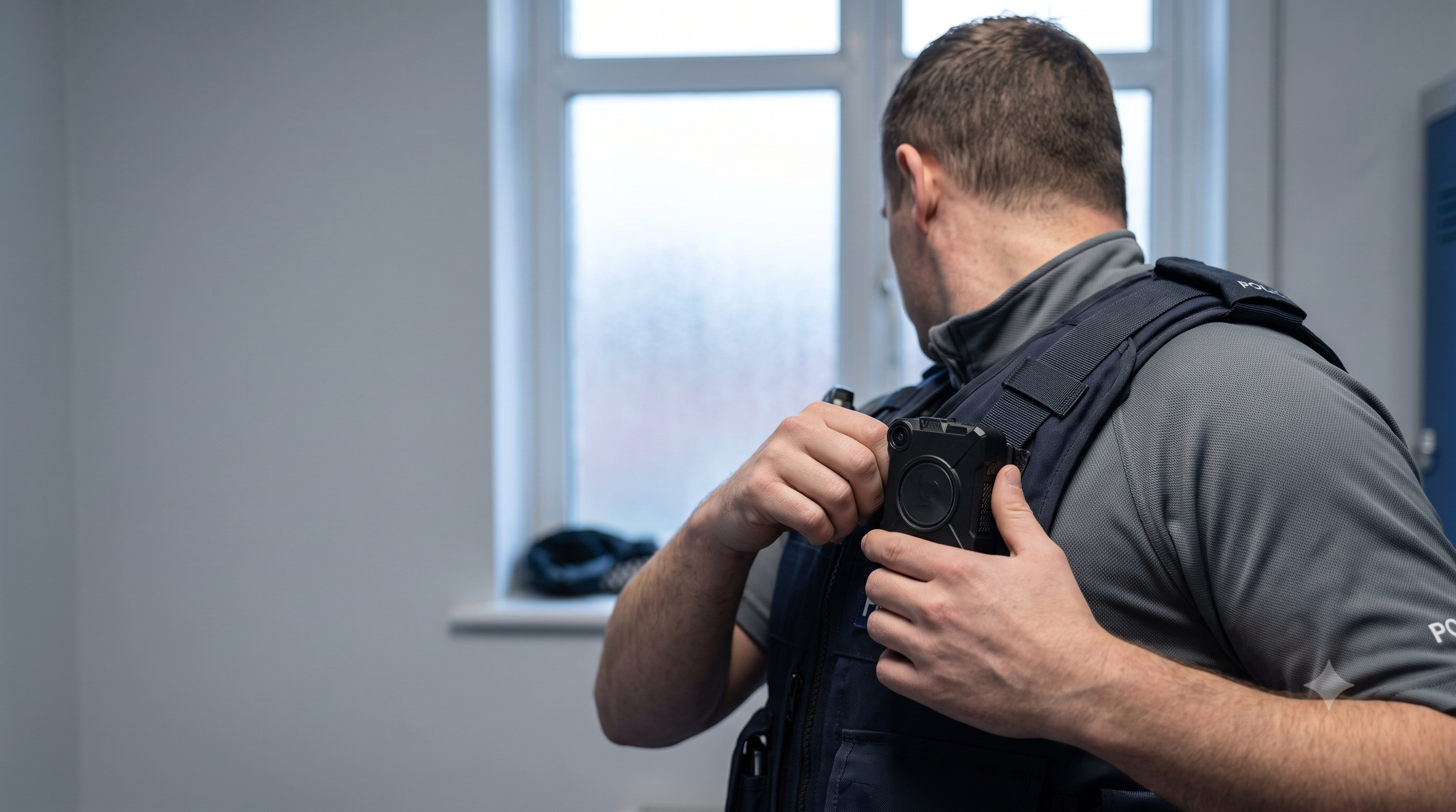
A robust body-worn camera (BWC) policy must comprehensively cover: purpose and scope, activation rules, notification requirements, data retention periods, access controls, Subject Access Request (SAR) handling, special category data conditions, training requirements, and version control. The sections below outline exactly what each element must state and why it matters for organizational compliance.
What Most Organisations Skip When Deploying BWCs
Many organisations rush to deploy body-worn cameras before a formal policy is ever drafted. The hardware arrives, frontline staff clip them to their uniforms, and the actual policy is pushed to the back burner.
Operating in this order creates immediate legal vulnerability. Without a formally ratified policy, an organization cannot legally or operationally answer foundational compliance questions: Who has authorization to activate a camera? When is recording mandatory? How long is the footage kept? Who is permitted to view it?
These are not trivial procedural details. Under Article 5 of the UK GDPR, personal data must be collected for a specified, explicit, and legitimate purpose. If your organisation cannot clearly define and document that purpose from day one, every second of footage you record lacks a valid lawful basis and is technically illegal.
What a Defensible Body Worn Camera Policy Must Include
1. Scope and purpose
Your policy must open with a definitive statement outlining who the policy applies to and the precise reason the cameras are being deployed.
A police force, a retail outlet, and an acute mental health ward all use BWCs for radically different reasons. For law enforcement, the purpose focuses on gathering evidence and officer accountability. For a healthcare provider, it centers on lone worker protection and clinical incident documentation.
Avoid vague, catch-all phrases like "safety and security." If your cameras are strictly intended to defuse active confrontations and are not meant for routine, continuous monitoring, your purpose statement must explicitly say so.
2. When to record: Activation rules
This is the operational core of your policy. Frontline staff require unambiguous parameters regarding when to hit the record button. Your policy must select one of three baseline frameworks:
Mandatory Activation: Staff must begin recording prior to entering any public-facing or client-facing interaction.
Discretionary Activation: Staff activate the camera when they professionally judge that an incident is escalating or an evidentiary record is required.
Event-Triggered / Pre-Buffer Recording: The camera runs continuously in a temporary caching mode (buffering audio and video) but only permanently saves the file once the operator actively presses the record button, retroactively capturing the lead-up to the incident.
Each framework requires careful consideration. Mandatory activation guarantees a complete record but generates vast volumes of data to store and review. Discretionary activation keeps data storage lean but creates operational gaps that can be intensely penalized during internal complaints or court proceedings. If your policy allows discretion, you must define what constitutes a "triggering incident" clearly enough that two different employees would make identical choices.
3. Public notification requirements
Under data protection laws, individuals have a fundamental right to be informed that they are being recorded. Your policy must mandate how and when staff give notice.
For standard overt surveillance, a clear verbal announcement at the moment of activation (e.g., "I am activating my body camera, which records audio and video") combined with highly visible signage or illuminated LEDs on the device uniform is the expected standard. In rare situations where immediate notification is impossible - such as an active physical assault - the policy must instruct staff to verbally state the recording status as soon as it is safe to do so.
4. Data retention and storage limitation
Keeping surveillance data longer than necessary is a direct violation of the UK GDPR’s storage limitation principle. Your policy must define strict, automated retention windows.
The National Police Chiefs' Council (NPCC) and College of Policing guidelines recommend a default retention period of 31 days for standard, non-evidential footage, after which files are automatically purged. Footage flagged as active evidence in an ongoing criminal, internal, or civil investigation should be segregated and retained in compliance with standard legal case file schedules, which can span several years.
Private sector entities must align their retention windows proportionately to their business needs. Retaining peaceful retail shift footage for 90 days when your stated purpose is strictly "incident response" will not survive regulatory scrutiny.
5. Role-based access controls
Your policy must restrict footage access to authorized personnel via role-based access lists (e.g., "Data Protection Officer," "Security Manager"), rather than naming specific individuals. Naming specific employees means your policy becomes legally outdated the moment someone changes roles or leaves the organization.
At a minimum, define:
Who is authorized to review footage for internal disciplinary or quality assurance reviews.
Who possesses the legal authority to approve third-party disclosures (e.g., releasing video to the police or legal counsel).
How access logs are maintained. Every single instance of a user viewing, downloading, or altering a video file must generate an immutable digital audit trail.
6. Subject Access Requests (SARs) and third-party redaction
Under the Right of Access, any individual captured on a body camera has a legal right to submit a Subject Access Request (SAR) to obtain a copy of that footage. Your policy must establish a precise workflow to locate, review, and deliver this data within the strict statutory deadline of one calendar month.
Crucially, BWC footage captured in public or semi-private environments almost always features third-party bystanders or colleagues who have not consented to disclosure. Releasing an unedited video file violates the data rights of those bystanders. Therefore, redacting (blurring) third-party faces, vehicle license plates, and identifying audio is a strict statutory requirement prior to disclosure.
Because a single minute of standard video contains thousands of individual frames, manual frame-by-frame video editing is an unworkable administrative burden. Enterprise organizations utilize automated redaction software, such as Secure Redact, to instantly identify and mask third parties at scale. This tool reduces compliance response times by over 80% on standard high-definition feeds (720p and above), freeing compliance teams to meet strict calendar deadlines.
Sector-Specific Compliance Elements
Law Enforcement
UK police forces must align all internal BWC and Body Worn Video (BWV) policies with the College of Policing Authorised Professional Practice (APP). Furthermore, any deployment utilized for targeted or covert surveillance must satisfy the strict judicial authorizations set out by the Regulation of Investigatory Powers Act 2000 (RIPA). Material processed for criminal prosecution must also strictly comply with disclosure mandates under the Criminal Procedure and Investigations Act 1996 (CPIA).
Healthcare & Special Category Data
Deploying body cameras within healthcare facilities - whether for NHS Trusts or private clinics - introduces Special Category Data under Article 9 of the UK GDPR. Video that records a patient’s visible physical condition, psychological distress, or confidential discussions regarding treatment handles sensitive health data.
Do not base your policy on patient consent. The ICO explicitly advises against utilizing consent as a lawful basis for security-driven BWCs, as an incapacitated or agitated patient cannot freely give or withdraw it. Instead, public healthcare organizations must anchor their policy in Public Task (Article 6(1)(e)), and private facilities in Legitimate Interests (Article 6(1)(f)). These must be paired with Article 9 exemptions—specifically Article 9(2)(h) (Health and Social Care Management) or Article 9(2)(g) (Substantial Public Interest), supported by a formal Schedule 1 condition under the Data Protection Act 2018. A comprehensive Data Protection Impact Assessment (DPIA) must be signed off by your DPO prior to camera deployment.
Retail and Private Security
For commercial retail operations, the ICO expects a documented Legitimate Interests Assessment (LIA) before cameras are deployed. The policy must clearly cite empirical evidence - such as a documented uptick in staff abuse or organized stock theft - to prove that the privacy intrusion of a body camera is entirely proportionate to the commercial risk.
Policy Maintenance and Next Steps
A compliance policy that frontline staff have never read provides zero legal protection. Your implementation strategy must mandate comprehensive onboarding training and documented annual refresher training for all camera operators. This training must explicitly instruct staff on activation protocols, public announcements, and how to handle members of the public who forcefully object to being filmed.
Finally, your written policy must feature rigorous version control. It should be formally reviewed at least once a year by your legal or data privacy team to ensure continuous alignment with shifting regulatory frameworks, such as the UK's Data (Use and Access) Act.
Integrating Automated Redaction Workflows
Once your policy framework is written, the practical bottleneck is managing execution. Secure Redact integrates directly with modern digital evidence management systems via secure APIs. The platform allows compliance teams to execute bulk video uploads, deploy automated AI masking across bystander identities, and generate legally compliant files for SAR or judicial disclosure without dragging videos into separate, insecure editing suites.
To see how automated redaction can safeguard your organization's surveillance pipeline, connect with the Pimloc team to schedule an enterprise demo.
Automate the redaction workflow your BWC policy depends on.
Try Secure Redact for free.
Frequently Asked Questions
-
Yes. Under the accountability principle of the UK GDPR, organizations are legally required to demonstrate that personal data is handled lawfully, fairly, and transparently. Because body cameras capture highly intrusive audio and video of the public, deploying them without a formalized, written policy detailing your lawful basis, purpose limitation, and retention schedules constitutes a direct regulatory breach.
-
For UK policing, standard non-evidential footage is held for a default window of 31 days before being automatically deleted. For the private sector and healthcare, there is no single statutory timeline; retention must follow the storage limitation principle. Footage must be deleted the moment its usefulness for your stated purpose expires. Keeping standard, non-incident footage beyond 14 to 31 days without a specific legal hold or active insurance dispute is highly difficult to justify to regulators.
-
A SAR is a formal request under data protection law wherein an individual demands access to all personal data an organization holds on them. If a member of the public or an employee is filmed by a BWC, they have a right to request access to that clip. The organization is legally obligated to locate the footage and provide access within one calendar month. Crucially, before the video is shared, any other individuals visible in the frame must be redacted to preserve their right to privacy.
-
No. The ICO and healthcare privacy frameworks heavily discourage relying on consent for security or incident-driven BWC deployment. If a patient experiences a medical crisis or an incident escalates, they lack the practical ability to freely grant, deny, or withdraw consent. Healthcare providers must instead rely on "Public Task" or "Legitimate Interests," paired with strict DPA 2018 Schedule 1 conditions regarding healthcare management or substantial public interest.
-
Your BWC policy must interface directly with your organization's standard HR disciplinary framework. If your activation rules dictate mandatory recording during specific events, any unexplained failure to record must be thoroughly documented by the employee in an incident log. Persistent, undocumented non-compliance with activation rules should be treated as a performance or disciplinary matter, as gaps in video can severely undermine the organization's position during court proceedings or formal public complaints.