
Why you need AI video analytics with anonymization in 2026

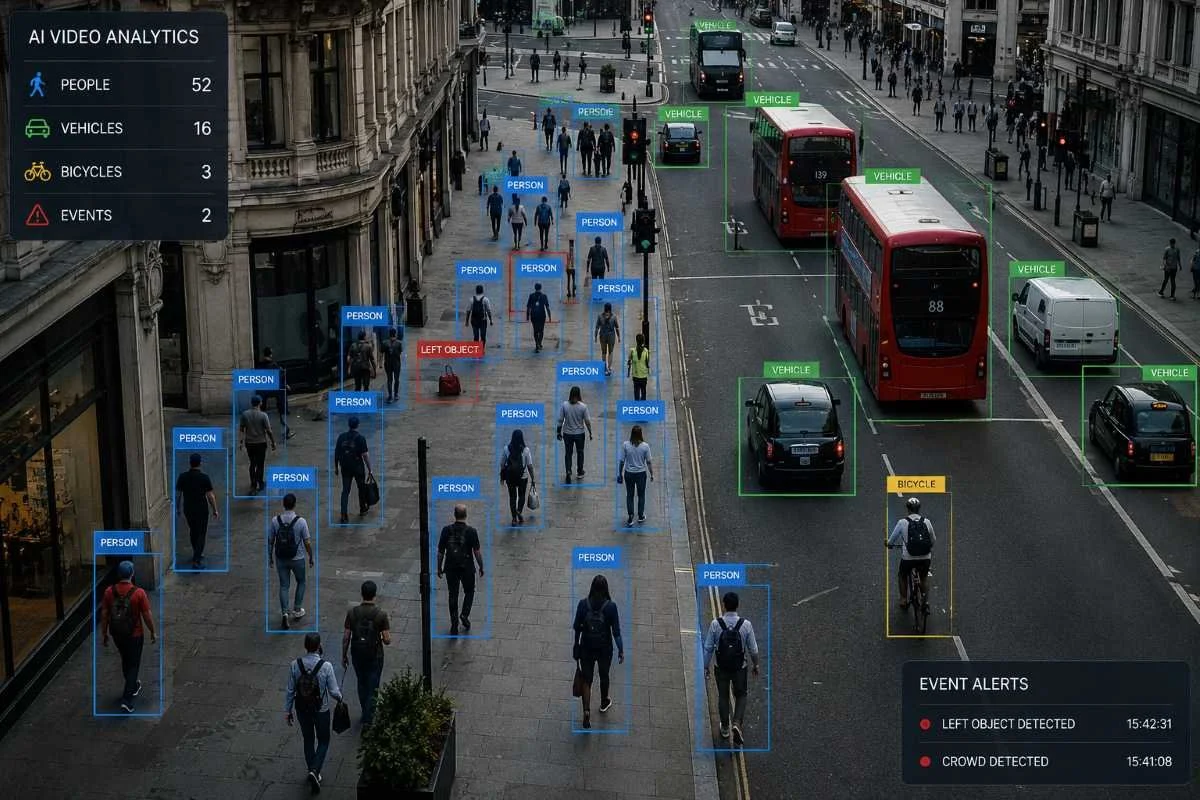
Artificial intelligence has transformed what organizations can learn from video. Modern analytics platforms can identify unusual behavior, detect safety risks, count people, monitor traffic flow, recognize objects, and generate valuable operational insights in real time. Video is no longer just a record of what happened, but an active source of business intelligence.
Yet as AI becomes more sophisticated, so do concerns surrounding privacy. The same systems capable of recognizing patterns and improving decision-making also process enormous amounts of personal information. Faces, license plates, employee badges, customer interactions, and countless other identifiers are routinely captured, analyzed, and stored, creating new responsibilities for organizations handling visual data.
In 2026, the conversation is shifting. The question is no longer whether businesses should adopt AI video analytics; it's whether they can do so responsibly. The organizations leading the way are combining powerful analytics with intelligent anonymization, ensuring they gain valuable insights without unnecessarily exposing the identities of the people appearing in their footage.
AI analytics is moving beyond traditional security
Video analytics was once associated almost exclusively with surveillance.
Today, organizations use AI to improve a wide variety of business functions, including:
Workplace safety
Manufacturing quality assurance
Retail operations
Logistics and fleet management
Healthcare efficiency
Smart building management
Campus security
Customer experience analysis
Instead of simply recording events, AI can identify patterns, generate alerts, and support faster operational decisions across entire organizations.
As camera networks continue to expand, the amount of data available for analysis grows exponentially.
More data creates greater privacy responsibilities
Every camera captures more than operational activity.
It also records people going about their daily lives.
Employees entering offices.
Patients walking through hospital corridors.
Students moving between classrooms.
Customers browsing store shelves.
Contractors delivering equipment.
Visitors attending public events.
Many of these individuals have no direct connection to the reason the footage is being analyzed, yet their identities remain visible unless organizations actively protect them.
This is one of the biggest challenges facing enterprise AI adoption: extracting value from video without collecting or exposing more personal information than necessary.
Why anonymization strengthens AI rather than limiting It
Some organizations worry that anonymizing footage will reduce the effectiveness of AI analytics.
In practice, the opposite is often true.
Many operational insights do not depend on knowing exactly who someone is. Crowd density, vehicle movement, queue lengths, equipment usage, occupancy rates, and safety compliance can all be measured without revealing personal identities.
By anonymizing unnecessary identifiers while preserving the underlying activity, organizations can continue benefiting from AI-powered analysis while significantly reducing privacy risks.
This principle, often referred to as privacy by design, is becoming increasingly important across regulated industries.
Regulations continue to raise expectations
Across the United States, organizations are facing growing expectations around the responsible handling of personal information.
State privacy laws continue to evolve, while industries such as healthcare, education, financial services, and law enforcement operate under additional regulatory requirements governing how sensitive data is collected, stored, and shared.
Even when anonymization is not explicitly required, regulators increasingly expect organizations to demonstrate that they have taken reasonable steps to minimize unnecessary exposure of personal information.
Building privacy into AI workflows from the outset is far easier than trying to retrofit compliance later.
AI helps organizations scale responsibly
One of the greatest advantages of AI is its ability to process information that would overwhelm human reviewers.
A large organization may collect:
Thousands of surveillance clips every week
Continuous body-worn camera footage
Dashcam recordings
Drone inspections
Facility monitoring
Customer interaction videos
Mobile phone evidence
Training recordings
Reviewing every file manually is simply unrealistic.
AI enables organizations to identify relevant content quickly while simultaneously detecting the personal information that should be protected before footage is shared or analyzed further.
Smarter analytics lead to better decisions
AI video analytics is no longer limited to identifying security threats.
Organizations now use it to answer broader operational questions, such as:
Which production lines experience the most downtime?
Where do safety incidents occur most frequently?
How can warehouse traffic be improved?
Are emergency exits remaining accessible?
Which customer areas experience congestion?
How efficiently are facilities being used?
These insights help leaders improve operations without relying solely on manual observation or fragmented reporting.
When anonymization is built into the workflow, decision-makers gain the information they need without unnecessarily exposing individuals who happen to appear on camera.
Integrating analytics into enterprise workflows
The most successful AI deployments are those that fit naturally into existing business processes.
Video analytics often integrates with:
Security operations centers
Incident management platforms
Business intelligence dashboards
Evidence management systems
Cloud storage
Compliance reporting
Access control platforms
Operational analytics tools
Rather than creating isolated datasets, modern organizations connect AI insights with broader enterprise systems to improve collaboration and decision-making.
Privacy protection should be integrated in exactly the same way.
Looking beyond face blurring
Effective anonymization extends well beyond obscuring faces.
Depending on the environment, organizations may also need to protect:
License plates
Identification badges
Printed documentation
Computer monitors
Medical records
Personal belongings
Audio conversations
Confidential business information
The ability to recognize multiple categories of sensitive information is becoming increasingly important as organizations expand the ways they use AI-powered video.
Choosing technology that supports future growth
The AI landscape continues to evolve rapidly, making flexibility an important consideration.
Organizations evaluating video analytics platforms should think beyond immediate requirements and consider whether a solution can adapt to:
Additional camera deployments
New AI detection models
Emerging privacy regulations
Cross-border operations
Cloud migration strategies
Higher processing volumes
New integration requirements
Scalable platforms reduce long-term costs while allowing organizations to expand their use of AI with confidence.
Where intelligent analytics and privacy come together
Organizations often deploy separate tools for video analytics and privacy protection, creating unnecessary complexity as footage moves between different systems. A more effective approach is to build privacy into the same workflows that generate operational insights, allowing analytics and compliance to work side by side rather than competing for attention.
That is the direction our team at Pimloc has taken with Secure Redact. We developed Secure Redact to help organizations operationalize privacy without slowing the pace of investigations, security operations, or data-driven decision-making. Instead of simply masking sensitive information, our platform complements enterprise AI ecosystems by enabling organizations to prepare visual data for sharing, collaboration, and analysis while maintaining confidence that personal information has been handled appropriately.
Among the capabilities that support this approach are:
AI models that identify a wide range of privacy-sensitive objects, from faces and vehicle license plates to documents, screens, and visible identifiers
APIs that allow anonymization to become part of existing AI pipelines rather than a standalone process
Support for collaborative review, enabling different departments to validate redactions before information is released
Secure processing options suitable for organizations with strict data residency or infrastructure requirements
Batch automation that can process large collections of visual data with consistent privacy rules
Detailed reporting and audit functionality to demonstrate how media has been reviewed and anonymized
A unified platform capable of handling video, images, audio, and documents without requiring multiple specialist tools
With Secure Redact, organizations maximize the value of AI-generated insights while reducing the operational burden associated with manual privacy reviews. Instead of viewing anonymization as an obstacle, enterprises can make it a seamless part of their analytics strategy.
AI's next competitive advantage is responsible innovation
As AI video analytics becomes standard across industries, competitive advantage will depend on more than simply deploying the smartest algorithms. Organizations will increasingly be judged on how responsibly they collect, analyze, and share visual information.
Those that combine powerful analytics with intelligent anonymization will be better positioned to satisfy regulators, strengthen customer trust, accelerate collaboration, and extract greater value from their data. In 2026, the most successful AI strategies will not be defined solely by what organizations can see. They will be defined by how effectively they protect the people who appear in the footage.